Home-style braise
Red-Braised Pork Belly
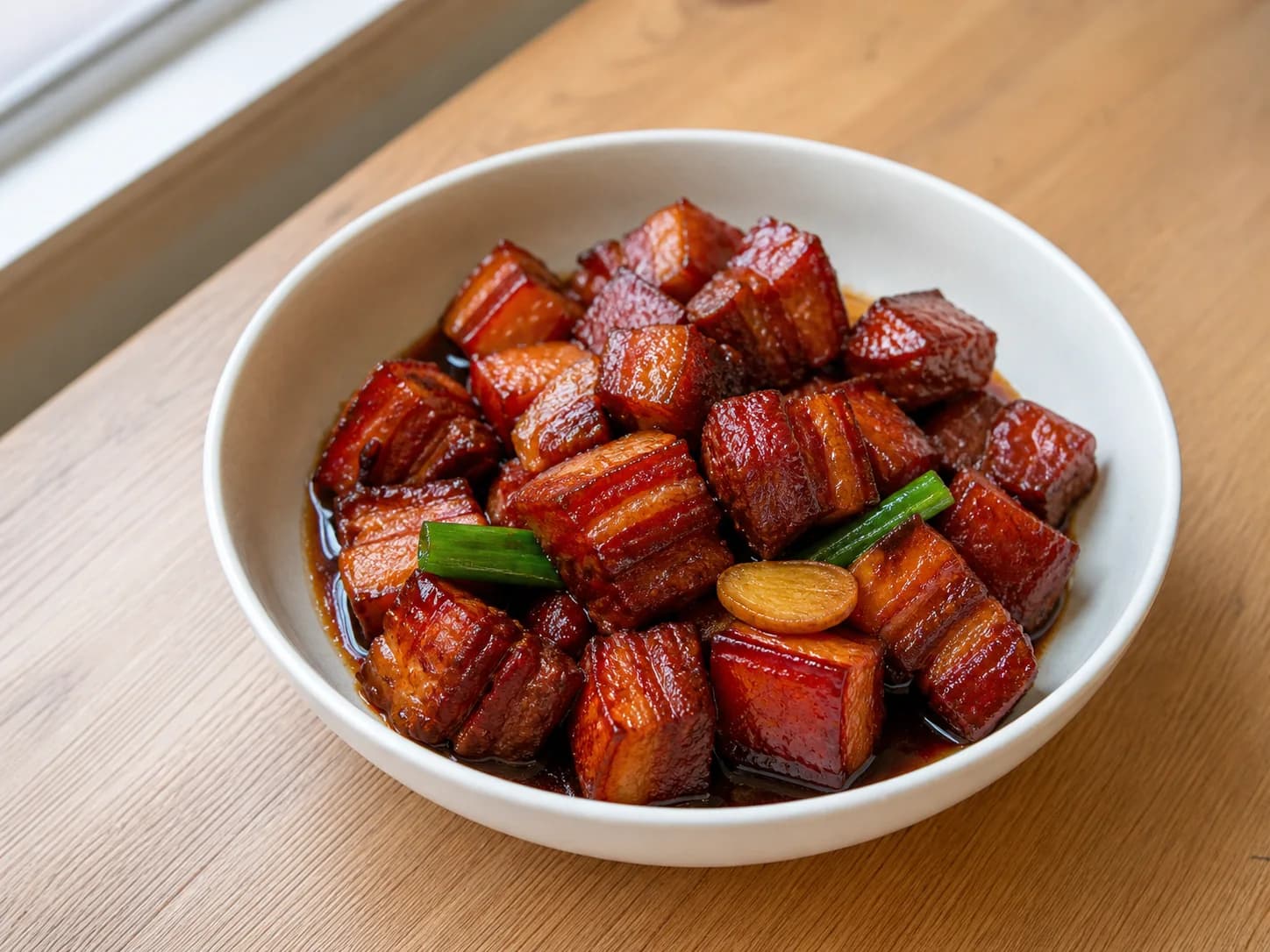
A beginner-friendly red-braised pork belly that skips dark caramelized sugar, ready in about 85 minutes with less risky hot-oil work.
Written and edited by CookPal
The short answer
For a beginner-friendly red-braised pork belly, render some fat from the pork first, then braise it with light soy sauce, dark soy sauce, a little sugar, and hot water. You do not need to make a deep caramel. Simmer until a chopstick slides into the pork fairly easily, then reduce the sauce uncovered.
- Servings
- Serves 3
- Prep
- 15 min
- Cook
- 70 min
- Difficulty
- Intermediate
Step-by-step method
- 1
Handle raw pork and separate tools
Cut the pork belly into about 3 cm cubes and pat it dry with kitchen paper. Do not use knives, boards, or plates that touched raw pork for cooked food.
Doneness cueThe pork has no obvious surface droplets, and the pieces are as even in size as possible.
- 2
Render some fat over medium heat
Put the pork in a cold pan and bring it to medium heat. Cook for 8 to 10 minutes, turning it occasionally. When the edges are lightly golden and fat has collected, pour off excess fat, leaving about 1 tablespoon in the pan.
Doneness cueThe pork edges are lightly golden, not blackened or producing heavy smoke.
- 3
Add sugar and aromatics
Turn the heat to low. Add the sugar, ginger, scallions, and star anise. Stir for about 1 minute so the sugar melts and coats the pork.
Doneness cueThe sugar is melted and barely bubbling. It does not need to become dark brown.
- 4
Season and add hot water
Add the cooking wine, light soy sauce, and dark soy sauce around the side of the pan. Stir, then add about 600 ml hot water until it nearly covers the pork.
Doneness cueThe sauce is evenly colored, with no clumps of unmelted sugar.
- 5
Braise gently until tender
Bring to a boil, skim off any foam, cover, then simmer over low heat for 50 to 60 minutes. Check once or twice; add hot water if the liquid gets low.
Doneness cueA chopstick can enter the lean part fairly easily, while each pork cube still holds its shape.
- 6
Reduce the sauce uncovered
Remove the ginger, scallions, and star anise. Turn to medium heat and reduce for 5 to 10 minutes, turning the pork gently. Taste first, then decide whether it needs up to 1 g salt.
Doneness cueThe sauce lightly coats the pork, while a small amount of flowing sauce remains in the pan.
How to read the heat
- Use medium heat while rendering pork so the fat comes out gradually; steady smoking means the heat is too high.
- During braising, keep small bubbles moving across the surface rather than a violent boil.
- Reduction can scorch quickly near the end. When dense large bubbles appear, watch constantly and turn off the heat in time.
Ingredient swaps
COOKING RECOVERY
Pause first, then make one small adjustment
The pork is still tough but the liquid is nearly gone
Add 150 to 200 ml hot water. Bring it back to a boil, then return to a low simmer and check every 15 minutes.
The finished dish is too salty
Stop reducing. Add some hot water and unseasoned cooked eggs or blanched vegetables, then simmer briefly so they take on flavor.
The bottom of the pan tastes burnt
Turn off the heat immediately and do not scrape the bottom. Move the upper pork and unburnt sauce to a clean pan; discard clearly blackened parts.
Common beginner mistakes
- Putting wet pork into the pan, which splatters and makes browning difficult.
- Cooking the sugar for color too long, which makes the sauce bitter.
- Keeping a rolling boil through the braise, so the liquid dries out before the pork turns tender.
- Adding salt before reducing without accounting for the salt already in the soy sauces.
Frequently asked questions
Do I have to make caramelized sugar for red-braised pork?
No. Beginners can melt sugar gently over low heat and use a little dark soy sauce for color. This lowers the chance of bitter sugar and hot-oil splatter.
Why use hot water?
Cold water suddenly lowers the pan temperature and can tighten the pork surface. Hot water makes it easier to maintain a steady braise.
How long does the pork need to braise?
Roughly 3 cm cubes commonly need 50 to 60 minutes at a low simmer, but the meat, pan, and heat all matter. Use a chopstick sliding in fairly easily as the test.
Why is red-braised pork bitter?
Common causes are over-darkened sugar, burnt aromatics, or a scorched pan during reduction. If the burnt taste is obvious, do not scrape the bottom; transfer the unburnt portion.
Can I make it ahead and reheat it?
Yes. Cool and refrigerate promptly, then reheat evenly to 73.9°C at the center before eating. If storage time or condition is uncertain, do not eat it.
Editorially checked; kitchen testing is being added
Published 2026-07-22 · Last updated 2026-07-22